On this page
- Morning or night: does it matter?
- With food or without food?
- What if I miss a dose?
- Taking folic acid with other vitamins and medicines
- Common timing myths
- Simple ways to make it a daily habit
- Does timing affect side effects?
- Timing over the long run: when to start and how long
- Frequently asked questions
- Sources
- There is no proven clinical advantage to taking routine folic acid in the morning or at night; consistency matters more 12.
- Folic acid is well absorbed with or without food: nearly 100% on an empty stomach and at least 85% with food 2.
- If folic acid makes you feel queasy, taking it with food can help 3.
- Missed a dose? Do not double up unless told to; just resume your normal schedule 3.
- With methotrexate, follow your prescriber's exact schedule; folic acid is usually taken on a different day 1.
There is no best time of day to take routine folic acid: morning and night have no established clinical advantage over each other.12 What matters is taking it consistently every day, with or without food, unless a prescriber has given you condition-specific timing, as often happens with methotrexate.13
Below: how food affects absorption, what to do about missed doses, how to fit folic acid in with other medicines, and simple ways to make it a habit.
Morning or night: does it matter?
No, not for routine folic acid. There is no evidence-based best time for routine supplementation, and consistency and the prescribed schedule matter more than the hour.12
That gives you freedom to choose the time that suits your day:
| If you... | A time that may work |
|---|---|
| Already take other morning tablets | With breakfast or your other morning medicines |
| Feel queasy taking pills on an empty stomach | With your largest meal 3 |
| Forget things in the morning rush | With dinner or before bed |
| Take a prenatal vitamin | Whenever the label or your clinician suggests, consistently |
| Take methotrexate | Exactly as your prescriber directs 1 |
With food or without food?
Both work. Folic acid is well absorbed either way.32
| How you take it | Approximate bioavailability | DFE conversion |
|---|---|---|
| Folic acid on an empty stomach | Nearly 100% 2 | 1 mcg DFE = 0.5 mcg folic acid 2 |
| Folic acid with food | At least 85% 2 | 1 mcg DFE = 0.6 mcg folic acid 2 |
| Natural folate in food (for comparison) | About 50% 2 | 1 mcg DFE = 1 mcg food folate 2 |
This difference is the reason labels use Dietary Folate Equivalents (DFE): a microgram of folic acid is not nutritionally identical to a microgram of food folate.2 You do not need to time folic acid around meals to get the benefit, but taking it with food can make it easier if you get nausea.3
What if I miss a dose?
Do not double the next dose unless a clinician or the product instructions explicitly tell you to. Simply resume your normal schedule, and ask a pharmacist if you are unsure.3
Routine folic acid also does not need "cycling" or scheduled breaks.3 Daily, steady intake is the goal.
If you are taking folic acid to prevent neural tube defects, the most useful thing is not the exact hour but making sure it is part of every day, starting at least one month before conception.5 See how much folic acid for pregnancy for the full timeline.
Taking folic acid with other vitamins and medicines
Iron, B12, and multivitamins
Folic acid, iron, and vitamin B12 are commonly combined in prenatal and multivitamin products, because each has a distinct role in blood formation or pregnancy.62 Taking them together is fine. The main caution is not the combination itself but using folic acid to self-treat unexplained anemia without checking for B12 deficiency and other causes.72 Read more in folic acid and vitamin B12.
Methotrexate: timing is prescriber-specific
Methotrexate works against folate pathways, and timing rules for folic acid with methotrexate are different from routine use.81
- In low-dose methotrexate for conditions such as rheumatoid arthritis or psoriasis, a commonly recommended U.K. regimen is 5 mg folic acid once weekly, on a different day from methotrexate.1
- Folic acid is usually avoided on the methotrexate day in inflammatory-disease protocols.910
- Regimens vary by country, condition, dose, kidney function, and specialist protocol, so follow your exact prescription rather than a schedule from the internet.1
- Do not add an over-the-counter folic acid product on top of prescribed folate without checking with your prescriber.9
High-dose methotrexate for cancer uses a different drug, leucovorin (folinic acid), on precise schedules. Folic acid is not a substitute for it.1110 Our guide to methotrexate and folic acid covers this in more detail.
Other medicines
Antiseizure medicines such as phenytoin, carbamazepine, and valproate can lower folate status, and supplemental folate can affect drug levels or seizure control.25 Sulfasalazine can reduce folate absorption.2 Anyone using prescription medicines should tell their clinician and pharmacist about every vitamin and supplement they take.12
| Medicine | Timing guidance |
|---|---|
| Methotrexate (low-dose) | Follow the prescriber; usually not on methotrexate day 19 |
| Methotrexate (high-dose, oncology) | Leucovorin rescue on a strict schedule; not folic acid 1011 |
| Antiseizure medicines | Coordinate with neurology or obstetrics 25 |
| Sulfasalazine | Ask whether dietary or supplemental folate is advised 2 |
| Iron, B12, multivitamins | Can be taken together 2 |
Common timing myths
| Claim | What the evidence says |
|---|---|
| "Folic acid must be taken in the morning to work." | No time of day has an established clinical advantage for routine use 12 |
| "You have to take it on an empty stomach." | It is well absorbed with or without food 32 |
| "If you miss a day, take two the next day." | Do not double a dose unless a clinician or the label says so 3 |
| "You should take breaks so your body does not get used to it." | Routine folic acid does not require cycling 3 |
| "Methotrexate patients can take folic acid any day they like." | Follow the prescriber; folic acid is usually avoided on the methotrexate day 19 |
Simple ways to make it a daily habit
Because consistency matters more than the clock, the best routine is the one you will actually keep. A few ideas that many people find useful:
- Anchor it to an existing habit, such as breakfast, your morning coffee, or brushing your teeth at night.
- Keep the bottle where you will see it, out of reach of children, near where you eat or get ready.
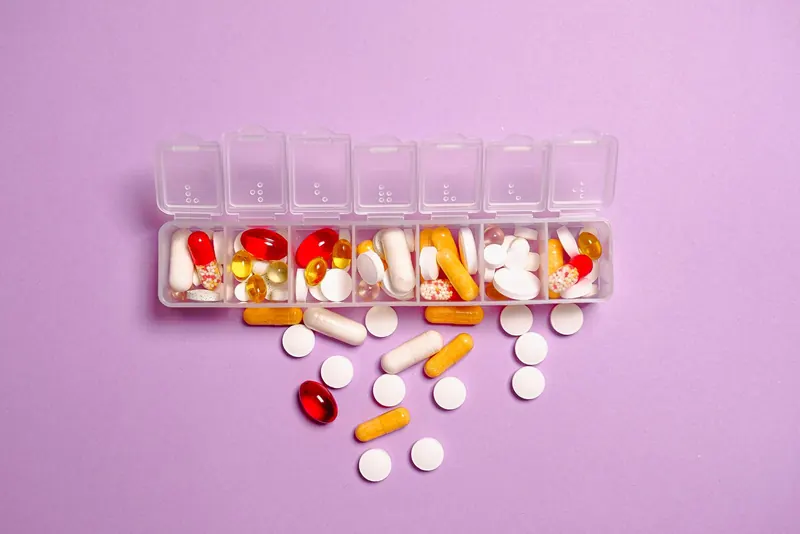
- Use a weekly pill organizer so you can tell at a glance whether today's dose is done.
- Set a phone reminder for the first few weeks until the habit sticks.
- Pick one product. If your prenatal or multivitamin already lists 400 mcg of folic acid, you may not need a second folic acid tablet; check the amount in parentheses on each label.24
If you take several medicines on a fixed schedule, ask your pharmacist to help you build a daily plan that fits folic acid in safely.12
Does timing affect side effects?
Most people tolerate folic acid well. Minor reported effects include nausea, reduced appetite, gas, or bloating.3 If you notice these, taking folic acid with food is a simple fix to try.3
Severe allergic symptoms, breathing difficulty, or swelling need urgent medical care.3 For a fuller list, see folic acid side effects.
Timing over the long run: when to start and how long
Daily timing is flexible, but calendar timing matters a lot in pregnancy. USPSTF recommends starting a daily folic acid supplement at least one month before anticipated conception and continuing through the first two to three months of pregnancy.5 CDC recommends 400 mcg every day for anyone who could become pregnant.4
That is because the neural tube closes about 26 to 28 days after fertilization, often before pregnancy is recognized.1314 Starting late is still better than not starting.13
For how much to take in each situation, see how much folic acid should I take.
Frequently asked questions
Is it better to take folic acid in the morning or at night?
Should folic acid be taken on an empty stomach?
Can I take folic acid with my other vitamins, iron, or B12?
What happens if I forget to take folic acid one day?
Skip the missed dose and take the next one as usual. Do not double a dose unless a clinician or the product instructions say to, and ask a pharmacist if you are unsure 3.
Do I need to take breaks from folic acid?
No. Routine folic acid does not require cycling 3. If you were prescribed it for a set period or a medical reason, follow your prescriber's plan.
Sources
- NHS Specialist Pharmacy Service. Using folic acid with methotrexate in rheumatoid arthritis.
- NIH Office of Dietary Supplements. Folate - Health Professional Fact Sheet.
- NHS (UK National Health Service). About folic acid.
- Centers for Disease Control and Prevention (CDC). About Folic Acid.
- U.S. Preventive Services Task Force (USPSTF). Folic Acid Supplementation to Prevent Neural Tube Defects: Recommendation.
- National Heart, Lung, and Blood Institute (NHLBI). Anemia in Brief.
- PubMed Central, NIH. Excess Folic Acid and Vitamin B12 Deficiency (Miller, 2024).
- MedlinePlus, U.S. National Library of Medicine. Methotrexate: Drug Information.
- NHS (UK National Health Service). Taking Methotrexate with Other Medicines and Herbal Supplements.
- MedlinePlus, U.S. National Library of Medicine. Leucovorin Injection: Drug Information.
- MedlinePlus, U.S. National Library of Medicine. Leucovorin: Drug Information.
- MedlinePlus Magazine, NIH. Did You Know? Supplements and Medications Can Interact in Unexpected Ways.
- U.S. Preventive Services Task Force (USPSTF). Folic Acid Supplementation to Prevent Neural Tube Defects: Final Recommendation Statement.
- NHS (UK National Health Service). Common questions about folic acid.
- PubMed, NIH. Guidelines for the Diagnosis and Treatment of Cobalamin and Folate Disorders (Devalia, 2014).
This article is for general education and is not medical advice. Doses and needs differ from person to person, so talk with your clinician or pharmacist about your situation. Read our editorial policy and medical disclaimer.